
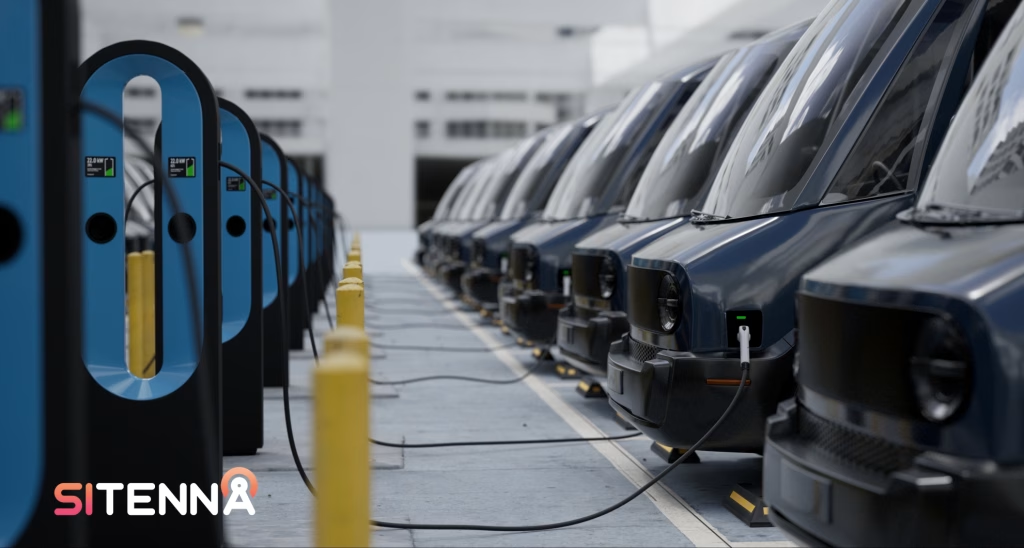
Across the globe, the EV revolution is accelerating. OEMs are shifting to all-electric fleets. Drivers are embracing cleaner transport. Governments are setting ambitious electrification targets.
And yet, there’s a disconnect.
The vehicles are ready. The demand is real. But the infrastructure is behind.
The conversation around EV charging delays often focuses on permitting, grid capacity, or construction timelines. But there’s a deeper, quieter issue at play — one that rarely comes up, but impacts everything:
Data. Or more accurately, fragmented, messy, and outdated data.
EV Deployment is a Data Problem Disguised as a Deployment Problem
After all, rolling out charging networks at scale isn’t just a matter of where to build — it’s about coordinating dozens of interlinked processes across site acquisition, leasing, design, permitting, utility connection, and operations.
At every step, data is essential:
- Which sites are viable?
- Who owns the land?
- What stage is this lease in?
- What’s been approved, submitted, or stalled?
- Which projects are delayed, and why?
But here’s the reality for most teams today:
- Site details live in spreadsheets.
- Lease documents pile up in scattered email chains.
- Teams track project timelines in offline spreadsheets.
- Critical updates scatter across departments and contractors.
As a result, this fragmented data landscape means decisions are slower, risks go unnoticed, and rollout velocity stalls.

Bad Data = Slow Rollouts
In practice, when data is fragmented or outdated, you lose the one thing you need most in an infrastructure build: clarity.
Without it, teams double-handle tasks, miss dependencies, and make decisions based on guesswork rather than insight. That leads to:
- Slower site control and permitting
- Costly miscommunications
- Delays in construction and energization
- Missed funding and regulatory deadlines
Ultimately, in a market where speed-to-deploy is everything, messy data is more than an inconvenience — it’s a strategic risk.
The Fix: One System, One Source of Truth
For example, what if every EV site was a living data object — intelligently connected to its contracts, communications, status, and stakeholders?
What if every team, from legal to engineering to operations, worked from the same up-to-date platform, with no need to chase files or duplicate information?
Therefore, that’s how you replace data chaos with rollout confidence.
The fix isn’t just better tools – it’s a connected, intelligent data foundation built specifically for infrastructure.

EV Growth Demands Data Infrastructure
Indeed, as the EV transition scales, data isn’t just supporting infrastructure — it is infrastructure. It’s the digital layer that drives every real-world milestone forward.
To keep up with EV demand, we can’t afford to keep losing time to disconnected systems and outdated workflows.
The hardware is ready. The policy is in place. The demand is rising.
The only question is whether your data is ready to keep up.
About Sitenna
Sitenna is the intelligent operations platform built to eliminate blind spots across modern infrastructure. By centralizing fragmented asset data and automating workflows from site acquisition through execution and management, Sitenna delivers the real-time visibility and control needed to keep projects on track. With Sitenna, infrastructure teams move faster, collaborate smarter, and scale confidently – turning complexity into clarity at every stage.
Contact us at sales@sitenna.com