

For the past few years, the dominant conversation around EV charging infrastructure has been speed.
How fast can we deploy? When can we secure sites? What accelerates permits?
But as networks mature, a new constraint is emerging. It’s not land. It’s not capital. It’s not demand.
It’s power.
The Shift from Location Strategy to Energy Strategy
Initially, early-stage EV rollout was about visibility and coverage. Operators targeted retail parks, highways, logistics hubs, and city centres. The priority was presence.
Now, however, those same operators are discovering a harder truth:
Specifically, the best commercial locations are not always the best energy locations.
In fact, Grid capacity constraints, long utility upgrade timelines, transformer limitations, and rising connection costs are reshaping deployment strategy. In some regions, connection lead times now exceed construction timelines.
As a result, that changes everything.
Therefore, site selection can no longer be driven purely by footfall and traffic flow. It must be driven by energy intelligence.

The Operators Who Win Will Think Like Utilities
As EV networks scale, charging operators must start thinking beyond real estate and into grid strategy.
Key questions now include:
- Where is spare grid capacity available today?
- Where are reinforcement upgrades planned?
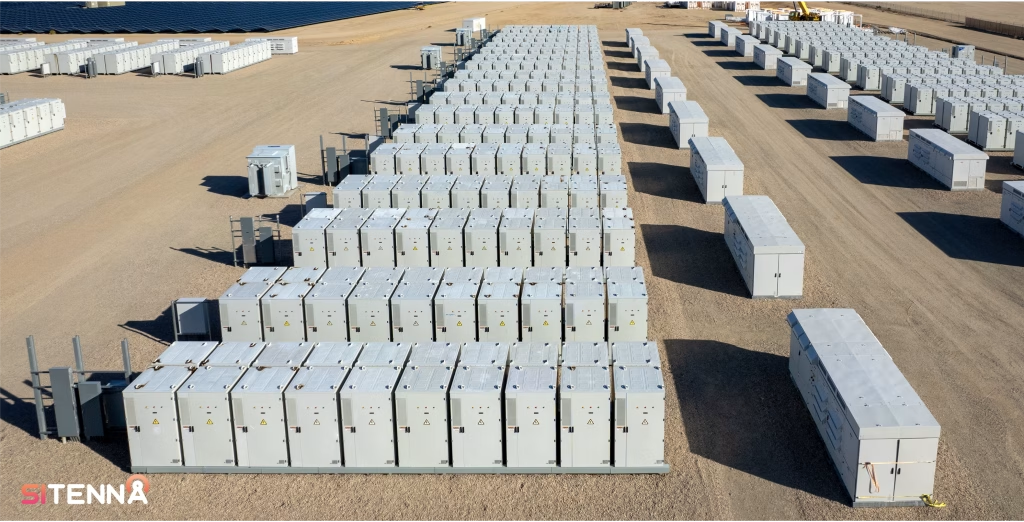
- Which sites justify battery storage integration?
- How do demand curves align with local load profiles?
- Can energy procurement and infrastructure rollout be coordinated?
Consequently, this is no longer just an infrastructure deployment exercise. It is a distributed energy orchestration challenge.
Battery Storage and Smart Load Management Change the Equation
As a result, forward-thinking operators are responding by integrating:
- On-site battery storage
- Smart load balancing
- Dynamic pricing models
- Energy management software
But layering technology onto fragmented operational systems only increases complexity.
To manage power strategy effectively, operators need:
- Visibility across site pipelines
- Coordination between energy teams and deployment teams
- Integrated contract and asset oversight
- Portfolio-level intelligence on performance and load
Because when power becomes the bottleneck in EV charging infrastructure, precision matters.
The Future of EV Charging Infrastructure Is Grid-Aware
Moreover, the next generation of EV infrastructure will not just be fast-charging. It will be grid-aware, data-driven, and strategically optimised.
In addition, the operators who understand energy constraints early – and integrate grid intelligence into site acquisition, project delivery, and asset management – will deploy faster and operate more profitably.
The ones who don’t will face stalled connections, escalating upgrade costs, and stranded assets.
Indeed, EV charging is evolving again.
However, the next competitive advantage won’t be speed alone.
Instead, it will be power intelligence.
About Sitenna
Sitenna is the intelligent operations platform built to eliminate blind spots across modern infrastructure. By centralizing fragmented asset data and automating workflows from site acquisition through execution and management, Sitenna delivers the real-time visibility and control needed to keep projects on track. With Sitenna, infrastructure teams move faster, collaborate smarter, and scale confidently – turning complexity into clarity at every stage.
Contact us at sales@sitenna.com