

For most of the past decade, scaling infrastructure meant building faster — more sites, more permits, more crews, and more capital moving through rollout pipelines.
In fact, speed was the advantage.
As a result, across telecom, edge, utilities, and distributed energy portfolios today, the nature of infrastructure scaling is changing. The constraint is no longer how quickly teams can deploy assets. It’s how effectively operators coordinate them once they exist.
Consequently, infrastructure operators are no longer managing rollout programs. They are managing living portfolios.
From Static Assets to Continuous Change
Traditional infrastructure operating models assumed a predictable lifecycle: acquire > permit > build > lease > operate.
Once a site entered service, activity slowed. Changes were episodic. Documentation stabilized. Agreements held steady.
That model is disappearing. Today, infrastructure portfolios are shaped by continuous layers of change: RF redesign cycles lease amendments tenant overlays densification programs equipment modernization edge integrations power upgrades compliance updates
In short, sites are no longer endpoints. They are platforms. And platforms evolve.
Engineering Activity No Longer Happens in Isolation
In earlier deployment cycles, teams managed engineering updates within discrete project workflows. Now they intersect directly with commercial agreements and portfolio strategy.
A change in antenna configuration can trigger: lease amendments structural analysis updates access adjustments construction scheduling tenant coordination portfolio-level tracking requirements
Therefore, engineering decisions are no longer technical events alone, they are operational events. And increasingly, they are portfolio events.

Agreements Are Becoming Dynamic Infrastructure Controls
Lease structures once defined static access rights. Today they govern change velocity.
As amendment stacking accelerates across portfolios, agreements increasingly determine: what can be upgraded when upgrades can occur how tenants interact where capacity exists which sites can densify first
Moreover, this shifts agreements from documentation to coordination infrastructure.
Meanwhile, operators who can track amendment activity across portfolios gain visibility into future deployment capacity before projects even begin. That visibility is becoming strategic.
Project Delivery Is No Longer a Linear Pipeline
Deployment used to follow a sequence, now it follows a network.
Multiple workflows overlap across the same assets: engineering updates tenant negotiations construction readiness maintenance activity portfolio optimization programs grid and power coordination
These layers don’t arrive in order, they arrive simultaneously. As a result, execution maturity now depends on whether operators can see how they interact. Because the risk is no longer slow deployment. The risk is invisible interaction between parallel change streams.
Asset Intelligence Is Becoming Operational Infrastructure
Infrastructure operators have always tracked assets. However, what’s changing is how often asset conditions evolve and how many decisions depend on that information being current.
Today, asset intelligence informs: upgrade sequencing tenant prioritization structural readiness capacity planning portfolio valuation densification strategy edge deployment readiness
Without a connected operational view, asset intelligence fragments across teams. And fragmented visibility slows coordination long before it slows deployment.
The Advantage Is Shifting from Speed to Orchestration
There was a time when the fastest builders scaled the furthest, that time is passing.
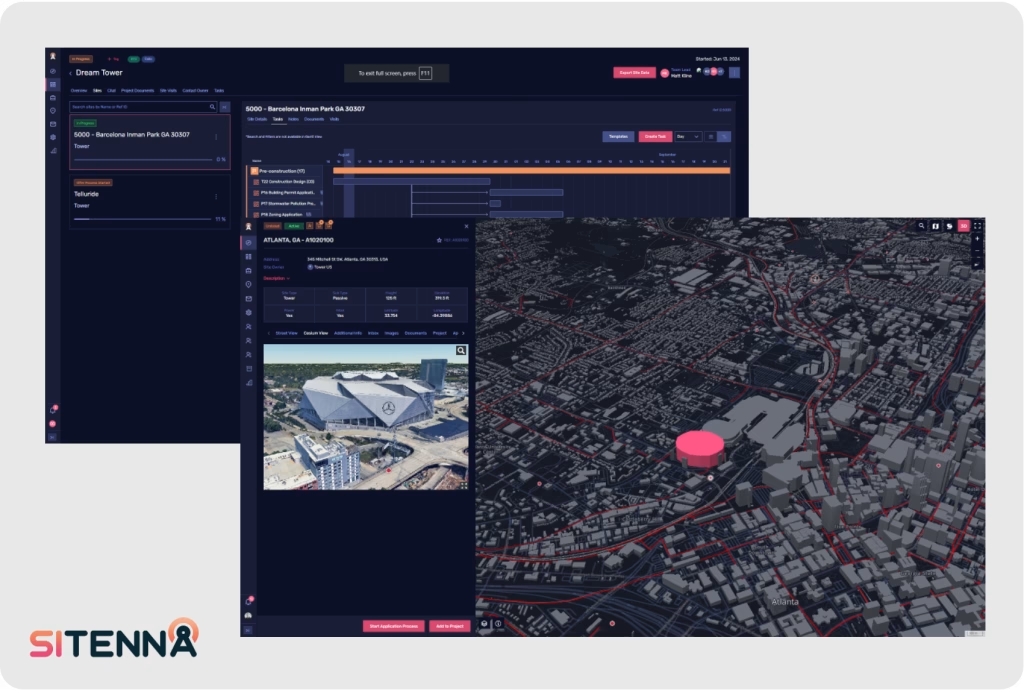
Now the advantage belongs to operators who can coordinate: engineering updates agreements delivery workflows tenant activity and portfolio intelligence as one connected system.
Ultimately, scaling infrastructure no longer means adding assets faster — it means managing change across assets more intelligently.
Infrastructure Is Entering Its Coordination Era
Across the industry, the signal is becoming clear: portfolios are no longer expanding outward — they are evolving inward.
- More activity per site
- More layers per agreement
- More interaction per workflow
- More intelligence per asset
Indeed, infrastructure is no longer defined by footprint alone — it is defined by coordination capability.
And the operators who build that capability into their operating model will be the ones best positioned to scale what comes next.
About Sitenna
Sitenna is the intelligent operations platform built to eliminate blind spots across modern infrastructure. By centralizing fragmented asset data and automating workflows from site acquisition through execution and management, Sitenna delivers the real-time visibility and control needed to keep projects on track. With Sitenna, infrastructure teams move faster, collaborate smarter, and scale confidently – turning complexity into clarity at every stage.
Contact us at sales@sitenna.com