

Indeed, a new phase of infrastructure evolution is underway.
It’s not just expansion. Rather, it’s recalibration.
From RF redesign to TIA renegotiation to rip-and-replace programs, infrastructure owners now face a clear reality: many assets built for yesterday’s demand no longer meet tomorrow’s performance needs.
This is not a gradual upgrade. Instead, this is a structural reset.
RF Design Is No Longer Static
In telecoms, RF design used to follow predictable cycles. Teams filled coverage gaps and layered in capacity. As a result, networks expanded outward.
Now the pressure is different.
5G densification, private LTE deployments, spectrum refarming, and increasing data use are forcing constant network improvement. As a result, small cells, edge deployments, and rooftop changes are becoming routine.
Today, RF environments are dynamic.
That means:
- Existing sites require redesign, not just maintenance
- Structural loading must be reassessed
- Interference modelling must be recalculated
- Lease agreements must accommodate new equipment configurations
RF design is no longer a one-time engineering event. It is an ongoing operational discipline.
And that requires better teamwork between engineering, site acquisition, legal, and asset management teams.

TIA Complexity Is Increasing
Once, Telecom Infrastructure Agreements were straightforward – define space, power, access, and term.
Today they are far more nuanced.
Multi-tenant colocation. Equipment swaps. Spectrum shifts. Structural upgrades. Amendment stacking. Escalator clauses. Power expansion rights.
Each change to a site can trigger TIA amendments, landlord talks, and approval workflows. In fact, across portfolios of hundreds or thousands of sites, this complexity compounds quickly.
When teams manage TIA documentation, RF changes, and construction milestones in separate systems, visibility erodes.
The result?
- Delayed amendments
- Inconsistent lease terms
- Increased compliance exposure
- Revenue leakage from untracked modifications
TIA management has become as strategic as RF planning.
Rip-and-Replace Is Becoming Rip-and-Reset
Consequently, rip-and-replace programs are accelerating across utilities and telecoms.
Whether driven by security mandates, vendor consolidation, spectrum shifts, or grid upgrade initiatives, operators are removing and re-engineering legacy infrastructure at scale.
But rip-and-replace is rarely just about hardware.
It triggers:
- Contract reviews
- Structural assessments
- Power recalculations
- Regulatory filings
- Contractor coordination
- Asset reclassification
- Financial adjustments
Moreover, at portfolio scale, this becomes a coordination challenge, not just an engineering one.
In short, rip-and-reset requires infrastructure owners to treat every site as a living data object – connected to agreements, engineering records, compliance records, and performance metrics.
Without structured visibility, programs stall. Costs escalate. Meanwhile, timelines slip.
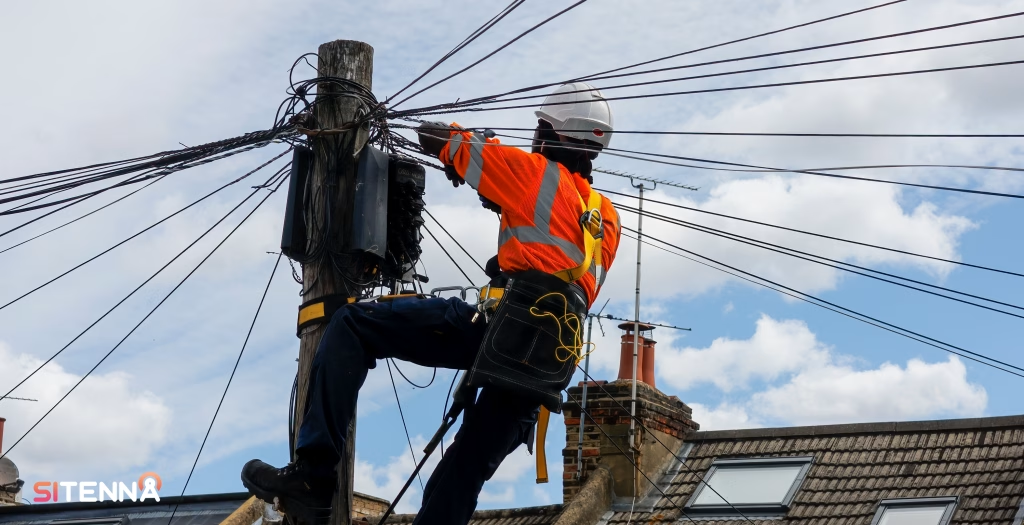
The Common Thread: Infrastructure Is Now Iterative
Until recently, the infrastructure model was linear:
Acquire. Build. Lease. Maintain.
Instead, the new model is iterative:
Design. Redesign. Amend. Upgrade. Optimise. Replace. Expand.
And every iteration increases complexity.
Therefore, telecom operators and utilities that still manage RF plans, TIA records, and rip-and-replace workflows in separate silos will struggle to maintain speed and compliance.
However, the ones who succeed will operate with:
- Unified asset intelligence
- Connected engineering and contract data
- Real-time portfolio visibility
- Structured workflows across teams and contractors
Because the next decade of infrastructure will not be defined by initial deployment.
Instead, it will be defined by how well we manage ongoing change.
Rip. Reset. Rebuild.
The winners will be those who can coordinate it all.
About Sitenna
Sitenna is the intelligent operations platform built to eliminate blind spots across modern infrastructure. By centralizing fragmented asset data and automating workflows from site acquisition through execution and management, Sitenna delivers the real-time visibility and control needed to keep projects on track. With Sitenna, infrastructure teams move faster, collaborate smarter, and scale confidently – turning complexity into clarity at every stage.
Contact us at sales@sitenna.com